
Made in Europe: Over 70% European content is already possible – why settle for less?
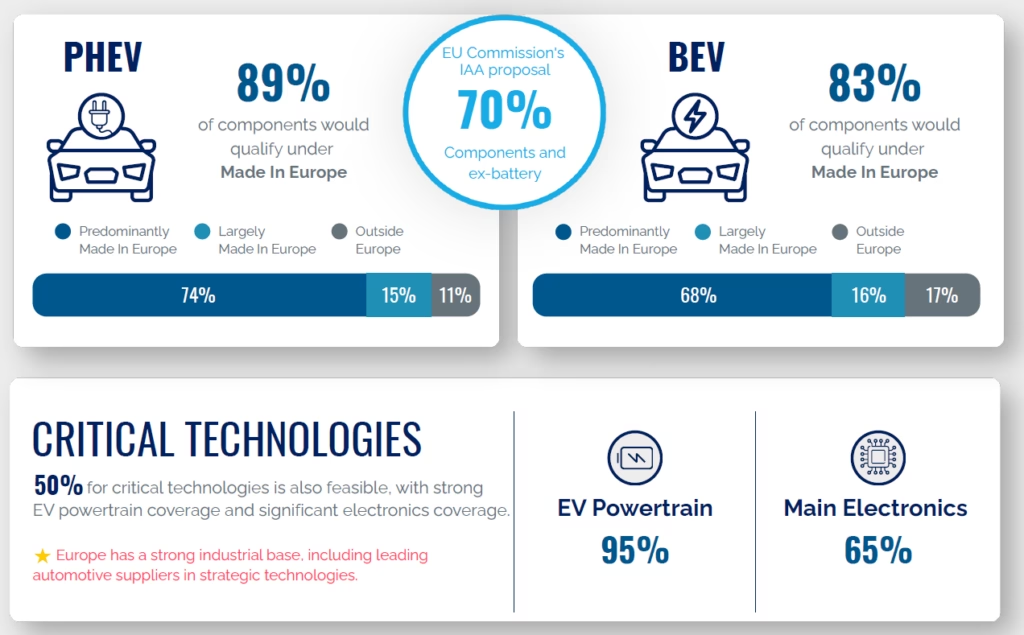
CLEPA, the European Association of Automotive Suppliers, today released new findings from Roland Berger, showing that the combined value of components made in Europe reaches up to 89% for plug-in hybrid electric vehicles (PHEVs) and 83% for battery-electric vehicles (BEVs). These figures indicate that the European automotive industry today comfortably exceeds the 70% ‘Made in Europe’ threshold proposed by the European Commission in the Industrial Accelerator Act.
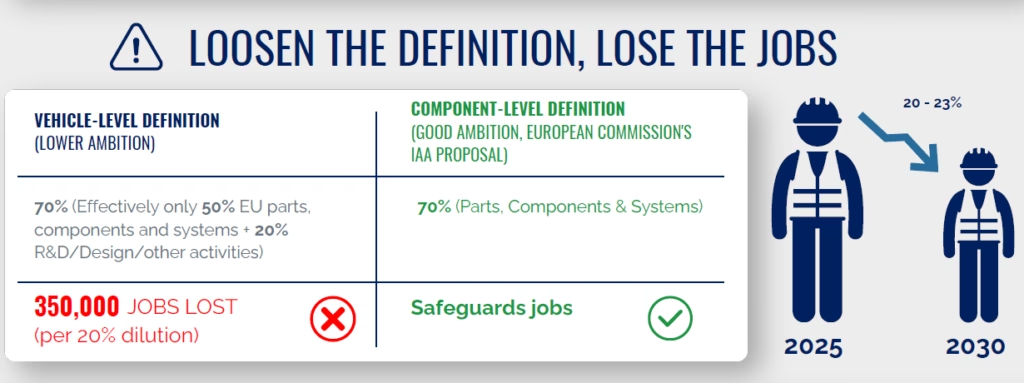
The analysis also warns that every percentage point the European Union weakens the Commission’s ‘Made in Europe’ targets will result in direct job losses across the continent.
“Cars are complex machines. A ‘Made in Europe’ threshold that ignores where the actual parts are built is a label that ignores the European worker. For every percentage point that the European Commission shifts from a component to a vehicle level definition, up to 15,000 jobs are at risk,” said Benjamin Krieger, Secretary General at CLEPA. “If we want a strong, sovereign automotive industry, we must retain the ability to build the components locally. Roland Berger’s latest data proves that capability is already present – we just need to ensure that it will stay that way.”
What the analysis found
Applying the Commission’s own ‘Made in Europe’ methodology – based on non-preferential rules of origin – the analysis by Roland Berger and CLEPA members found that the combined value of components predominantly or largely made in Europe already reaches 89% for plug-in hybrid electric vehicles (PHEVs) and 83% for battery-electric vehicles (BEVs).
The study reveals a supply chain that is well placed to meet ambitious criteria:
- PHEVs: Components accounting for 74% of vehicle value (excluding assembly and batteries) are predominantly made in Europe, with a further 15% largely made in Europe.
- BEVs: Components accounting for 68% of vehicle value are predominantly made in Europe, with a further 16% largely made here. This slightly lower share simply reflects a higher proportion of electronic and powertrain components currently sourced outside the region – an area primed for domestic growth.
Safeguarding critical technologies and supply chains
The analysis also dispels fears that ambitious localisation criteria could create supply shortages. The numbers confirm that the European supply chain is mature, resilient, and capable of supporting ambitious targets without disrupting production.
Furthermore, the data confirms the feasibility of a 50% localisation threshold specifically for critical technologies. With very high European coverage for EV powertrain components and significant coverage for main electronics already in place, CLEPA stresses that maintaining a dedicated threshold for critical technologies is essential to securing European sovereignty over the systems underpinning the future of mobility.
The Industrial Accelerator Act, however, is not a silver bullet: structural measures to improve the EU’s competitiveness as a location for manufacturing and investment are urgently needed to keep the core of automotive innovation firmly anchored in Europe.
See study results here:
By clicking the subscribe button you agree that CLEPA can process your personal data as detailed in our privacy policy