
Europe’s green transition is leaving consumers behind
Europe’s mobility transition is racing forward on paper, but consumers have to live everyday reality. As policy aggressively demands an accelerated shift, decision-makers are failing to take the public along. Instead, policymakers should work across political divides to deliver a balanced approach that offers consumers meaningful choices rather than a top-down mandate.
The reality of the transition is: Consumers value choice
A new YouGov/CLEPA survey offers a useful check on how Europeans view the mobility transition. The defining takeaway isn’t overwhelming support for a single, mandated technology, but the preference for diverse solutions. People are considering a wide range of powertrains for their next vehicle. They are making individual decisions based on how technologies fit their everyday needs.
The survey also points to a glaring disconnect between how politicians measure the transition and how citizens experience it. Growing battery-electric vehicle registrations are an important part of the picture, but they do not necessarily capture the needs of private consumers. A significant share of electric vehicle registrations comes from corporate fleets, while many households continue to weigh affordability, charging availability, energy costs and their own driving patterns when considering their next car.
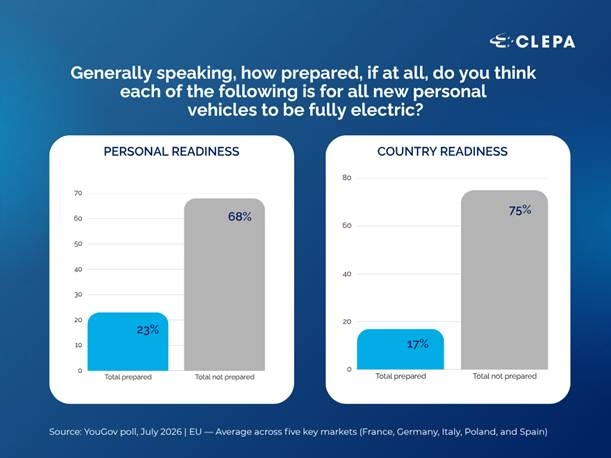
Policymakers should not assume that consumers will conform to a timetable based on desired policy outcomes. Regardless of Brussels’ intentions, people need a combination of accessible refueling and charging infrastructure, stable energy prices and a broad range of clean solutions.
To achieve a sustainable, just and affordable green transition Europe must make clean mobility easier for its citizens, rather than forcing the choice by regulation.
Flexibility drives the transition – it does not compromise it
The ongoing review of the EU’s CO₂ standards is therefore an opportunity. We should use it to listen to consumer’s needs, strengthening the conditions for electrification while preserving the flexibility to deploy the technologies that can already deliver real-world emissions reductions while the electrification infrastructure buildup is under way. The same is true for the debate on Clean Corporate Vehicles. It should incentivise the uptake of zero- and low-emission vehicles, but fundamentally leave the choice to consumers.
It is a dangerous and binary claim that offering technological choice means surrendering Europe’s climate ambitions. A recent study by the Technical University of Munich (TUM) makes the case for a more comprehensive framework that recognises every verifiable contribution to reducing a vehicle’s fossil footprint across its full life cycle in a realistic and fair manner. CLEPA has been sounding this alarm for years. The EU must measure what matters: the actual emissions reductions.
Negotiations have faced delays, but it is encouraging that France and Germany are now working on a joint path forward. The Council discussions in October will be make-or-break moment. Members of the European Parliament also have an important role to play, as this is a time for dialogue, openness, and alliances across political groups. Europe’s institutions must unite to find a balanced solution that gives both businesses and consumers the flexibility and confidence they need to actively drive the green transition, rather than being dragged along by it.
Benjamin Krieger
Secretary General, CLEPA
By clicking the subscribe button you agree that CLEPA can process your personal data as detailed in our privacy policy